
Effective task prioritization is defined as the deliberate process of ranking work by impact so that every available minute moves the right things forward. For busy professionals trying to prioritize tasks with limited free time, the challenge is not motivation. It is structure. Two frameworks stand out in 2026 productivity practice: the 1-3-5 Rule and the Eisenhower Matrix. Both force you to decide what matters before you start working, not after. Pair either framework with energy-aware scheduling and you stop reacting to your day and start directing it.
What are the most effective frameworks for prioritizing tasks with limited free time?
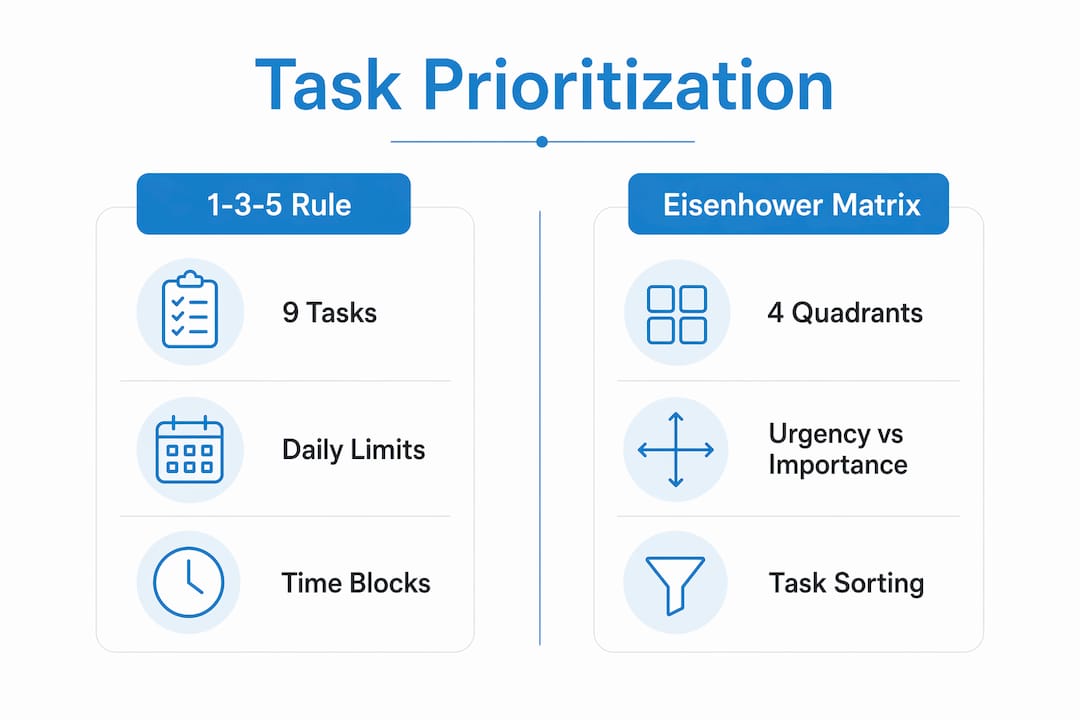
The 1-3-5 Rule is one of the clearest task management strategies available for constrained schedules. It limits your daily workload to exactly nine items: 1 big task (2–4 hours), 3 medium tasks (30–90 minutes each), and 5 small tasks (5–20 minutes each). That structure forces you to make hard choices before your day begins, which is exactly when your judgment is sharpest.
The Eisenhower Matrix organizes tasks across four quadrants: urgent and important, important but not urgent, urgent but not important, and neither. The key discipline is keeping each quadrant tight. No more than 10 tasks per quadrant is the 2026 industry standard. Exceeding that limit turns the matrix into another bloated to-do list, which defeats the purpose entirely.

Both frameworks share one critical feature: they require upfront prioritization. You cannot fill all nine slots of the 1-3-5 Rule or all four quadrants of the Eisenhower Matrix without deciding what to cut. That decision-making step is where most professionals fail. They add tasks freely and edit rarely.
| Framework | Task limits | Typical duration | Best for |
|---|---|---|---|
| 1-3-5 Rule | 9 items per day | 2–4 hrs / 30–90 min / 5–20 min | Daily planning with clear time blocks |
| Eisenhower Matrix | 10 items per quadrant | Varies by urgency and impact | Weekly sorting and delegation decisions |
Pro Tip: Never assign more than one "big" task per day under the 1-3-5 Rule. If a project feels too large for a single slot, break it into a defined deliverable that fits within 4 hours.
How can managing your energy optimize task prioritization and execution?
Energy management is more critical than time management for professionals with fragmented schedules. Scheduling demanding tasks during peak energy periods improves both output quality and focus duration. Time is fixed at 24 hours. Energy is renewable, but only if you treat it as a resource worth protecting.
Scott Young's research makes the case directly: productivity success depends on biological rhythms, not rigid schedules. Most professionals have a 2–3 hour peak window each day, typically in the morning, where focus and decision-making are at their strongest. Wasting that window on email or low-stakes admin is one of the most common and costly mistakes in how to prioritize work.
Three practices that align energy with task execution:
- Identify your peak window. Track your focus quality across three days. Note when you feel sharpest and when you start losing concentration. That pattern is your scheduling guide.
- Batch low-focus tasks. Grouping similar administrative tasks into one session reduces the cognitive cost of switching between different types of work. Emails, expense reports, and routine messages belong together, not scattered across your day.
- Set hard boundaries around peak time. Block your highest-energy window in your calendar before anyone else can claim it. Treat it like a meeting you cannot cancel.
Boundary-setting through intentional prioritization also creates space for rest, which prevents the late-night work sprints that erode performance over time. Rest is not a reward for finishing. It is a condition for performing well the next day.
Pro Tip: Schedule your single "big" task from the 1-3-5 Rule during your peak energy window. Everything else fills in around it.
What practical steps can you follow daily to set priorities for busy schedules?
Effective daily prioritization follows a repeatable sequence. Skipping any step pushes you back into reactive mode.
- Audit your time first. Effective executives start by tracking where time actually goes before building any schedule. Spend three days logging your activities in 30-minute blocks. The results are almost always surprising. Most professionals discover that low-value tasks consume far more time than they estimated.
- Apply the 1-3-5 Rule or Eisenhower Matrix to your task list. Do not start with a blank list. Start with everything on your plate, then cut it down to fit the framework's limits. The constraint is the point.
- Allocate time blocks by energy level. Place your big task in your peak window. Schedule medium tasks in your mid-energy periods. Reserve small tasks for low-energy slots like late afternoon.
- Batch administrative work. Group emails, messages, and routine decisions into one or two fixed sessions per day. This protects your peak focus for high-impact work.
- Compare planned versus actual time. Tracking the gap between estimated and actual task duration is the fastest way to build realistic plans. Most people underestimate task complexity by 30–50%. Closing that gap takes deliberate measurement, not guesswork.
- Build in buffer time. Reserve at least one small-task slot each day for unexpected requests or delays. A plan with no slack fails the moment reality intervenes.
Two mistakes that derail this system most often:
- Overloading the big task slot. Assigning a vague, multi-part project as your "one big task" guarantees you will not finish it. Define a specific deliverable that fits within 4 hours.
- Ignoring energy rhythms. Scheduling your hardest work in a low-energy window because it "fits the calendar" produces poor results and frustration. The calendar serves your energy, not the other way around.
How do you adjust your approach when free time still feels insufficient?
Persistent time pressure is usually a signal that your task list has grown faster than your capacity. Task-list inflation happens when you add tasks freely but rarely remove them. The fix is not working faster. It is editing more ruthlessly.
Recognizing the signs matters. If you regularly carry more than three unfinished tasks from one day to the next, your plan is not realistic. If your "small tasks" routinely take 45 minutes instead of 20, your estimates are off. Both patterns require recalibration, not more effort.
Practical adjustments when balancing tasks with limited time feels impossible:
- Break tasks into smaller parts. A task that keeps getting deferred is usually too large or too vague. Redefine it as a 20-minute action with a clear output.
- Delegate or defer deliberately. Not every task on your list belongs to you. Identify one item per week that can be handed off or pushed to a future date without real consequence.
- Protect focused work periods. Set boundaries around your peak window. Turn off notifications, close unnecessary tabs, and communicate your unavailability to colleagues during that block.
- Focus on one or two techniques at a time. Adopting 1–2 techniques consistently over several weeks outperforms any attempt to overhaul your entire workflow at once.
"The best time management strategy targets your biggest friction point and keeps practices simple enough for long-term adoption. Complexity is the enemy of consistency."
Experimentation is part of the process. If the 1-3-5 Rule feels too rigid for your schedule, try the Eisenhower Matrix for a week. If energy batching feels unnatural, start with just one protected morning block. The goal is a system you will actually use, not the theoretically perfect one.
Key Takeaways
Effective task prioritization with limited free time requires choosing a framework, aligning your schedule with your energy peaks, and editing your task list more often than you add to it.
| Point | Details |
|---|---|
| Use a daily framework | The 1-3-5 Rule caps your day at 9 tasks and forces prioritization before you start. |
| Cap each quadrant | Keep the Eisenhower Matrix to 10 items per quadrant to prevent list bloat. |
| Schedule by energy | Place your hardest task in your peak focus window, not just the first open slot. |
| Batch low-focus work | Group emails and admin into fixed sessions to protect high-impact time. |
| Track planned vs. actual | Measure how long tasks really take to build plans that reflect reality. |
Why I think most prioritization advice misses the real problem
Most productivity articles treat prioritization as a sorting problem. Pick the right framework, rank your tasks, and execute. That framing is incomplete. The real problem is that busy professionals do not have a shortage of frameworks. They have a shortage of honest self-assessment.
The professionals I have seen make the most consistent progress are not the ones using the most sophisticated systems. They are the ones who protect focused work time with the same seriousness they give to client meetings. They treat their peak energy window as non-negotiable. They cut tasks from their list without guilt, because they understand that a shorter, realistic list beats a long, aspirational one every time.
The other thing most advice ignores is the emotional weight of an overloaded task list. When your list is too long, every item on it feels urgent. That feeling is not a signal to work harder. It is a signal to edit. Reducing your list to what you can genuinely accomplish in a day does not lower your ambition. It raises your completion rate, which compounds into real progress over weeks and months.
Sustainable productivity is not about squeezing more into every hour. It is about making better decisions about which hours matter and what fills them. Start with one framework, protect one peak window, and measure one gap between planned and actual time. That is enough to change how your weeks feel.
— Rndom
Qweekly fits the way your week actually works
Most planning tools assume your schedule is clean and predictable. Yours is not, and neither is anyone else's who is managing work, family, and a side project at the same time.

Qweekly is built around that reality. Its weekly planning layout gives you a visual overview of your week without forcing you into rigid time blocks. The built-in 70% rule prevents you from overloading any single day, so your plan stays achievable even when life interrupts it. You can capture tasks quickly, drag them into the right slot, and reschedule anything that does not get done without starting over. If you want a place to put the frameworks from this article into practice, Qweekly's productivity notes are a good starting point.
FAQ
What is the 1-3-5 Rule for daily task planning?
The 1-3-5 Rule limits your daily task list to 9 items: 1 big task, 3 medium tasks, and 5 small tasks. It forces prioritization before the day starts by capping how much you can plan.
How many tasks should go in each Eisenhower Matrix quadrant?
No more than 10 tasks per quadrant is the current standard. Exceeding that limit creates the same overwhelm the matrix is designed to prevent.
Why does energy management matter for task prioritization?
Scheduling your most demanding tasks during your personal peak energy window produces better results than filling calendar slots based on availability alone. Biological rhythms directly affect focus and decision quality.
How do I know if my task list is too long?
If you regularly carry more than three unfinished tasks to the next day, your plan is not realistic. Recalibrate by breaking tasks into smaller parts or deferring items that have no immediate consequence.
What is the fastest way to improve daily prioritization?
Start by auditing where your time actually goes for three days. That data reveals the gap between how you think you spend your time and how you actually do, which is the foundation of any realistic plan.